Friday, February 27, 2015

THERMOMETER

Thermometer is a device used to measure temperature, by using materials that change in some way when either heated or cooled. In a mercury or alcohol thermometer, the liquid expands as it is heated and contracts when it is cooled, so the length of the liquid column is longer or shorter depending on the temperature. Modern thermometers are calibrated in standard temperature units such as Fahrenheit or Celsius.


In 1596, Galileo Galilei is often claimed to be the inventor of the thermometer. However the instrument he invented was a thermoscope, the predecessor to the thermometer.  The thermoscope is a thermometer without a scale. It indicates differences in temperature if the temperature is higher or lower.


Savants had found out that it might be possible to use air and water to invent a "ruler" or scale that would mark the grades from cold to hot and back again. They experimented with thermoscope involving a column of air in a tube with one end in a container of coloured water. In 1610, Galileo tried it with wine instead, and so is credited with the first alcohol thermometer.

The Italian, Santorio Santorio (1561-1636) is generally appreciated for applying a scale to an air thermoscope around 1612 and thus is thought to be the inventor of the thermometer as a temperature measuring device. Santorio's instrument was an air thermometer. Its accuracy was poor due to the effects of varying air pressure on the thermometer.

The first sealed thermometer was designed in 1641 for the grand duke of Tuscany. It used alcohol, and it had degree marks. But the man who used the freezing point of water as the "zero" or starting point was a Londoner, Robert Hooke, in 1664. An astronomer called Roemer in Copenhagen chose ice and the boiling point of water as his two reference points, and started keeping weather records.

Daniel Gabriel Fahrenheit (1686-1736) was the German physicist who invented the alcohol thermometer in 1709, and the mercury thermometer in 1714. In 1724, he introduced the temperature scale that bears his name - Fahrenheit Scale.

In 1724, a German instrument maker called Gabriel Fahrenheit settled on mercury as the most suitable liquid for measuring temperature.


 He calibrated his first thermometer using a mixture of ice and water with sea salt as his zero. But salt water has a much lower freezing point than ordinary water, so for his purposes he chose his freezing point as 30, and the temperature inside the mouth of a healthy human as 96. 

With those three points, he established the boiling point of water at 212 and later adjusted his freezing point of water to 32. This way, he could count 180 degrees between boiling and freezing, at sea level.

Two decades later, Linnaeus - the Swede who invented the taxonomic system naturalists now use for naming species - and a Swedish astronomer called Anders Celsius separately worked out a scale of just one hundred degrees between freezing and boiling points. Because there were 100 steps between the two states, it was called a "centigrade" scale.

Lord Kelvin took the whole process one step further and led to the invention of the Kelvin Scale in 1848. The Kelvin Scale measures the ultimate extremes of hot and cold. Kelvin developed the idea of absolute temperature, often called the "Second Law of Thermodynamics", and developed the dynamical theory of heat.

He used the centigrade scale, but started from absolute zero, the point at which all molecular motion stops, the lowest conceivable temperature in the universe. This turned out to be -273.16C.


Thursday, February 26, 2015

GUN

Weapons have been used from time immemorial. But they have been developed from time to time, catering to the needs of humans. The use of Longbow and swords are found in the historical wars or battles. Rat race of collecting arms for the national détente is not new. Whether for purpose of self defense or offence, guns have a fascinating history.

Mythical monk from Germany is believed to have given idea of propelling projectile with the gunpowder in the 1300s. And Arabs are known to be inventors of earliest cannon named madfaa. This cannon was a wooden bowl with gunpowder in it and cannonball was made to stand on bowl’s rim. Its name that meant pot of fire, described how the iron bottle gripped gunpowder. Modern cannons were developed from this model only.

It was in 1364 that mankind first recorded the use of a firearm. These weapons, called “hand cannons,” were the first step in the creation of guns.
hand cannon
Originally, a wick was tied to “touch hole” inside of the barrel of guns. Then, when one lit the wick, the powder would inevitably be ignited inside, creating the reaction needed to launch the projectile. Obviously it was awkward to hold both gun & slow match while trying to dip the match to the touch hole of the hand cannon.

It was due to the matchlock gun arrived in the 1400s that guns began to evolve. This particular firearm was the first gun that used mechanics to release a bullet.
matchlock gun
Serpentine, the device was S-shaped and lowered slow match in priming pan whenever a gunman pressed the trigger. Introduction of this device had modernized gunnery while letting the aimers shoot and aim using both their hands. Musket was around 5-6 feet long with twenty pounds of weight. Supported by forked stick, musket users were known as musketeers.

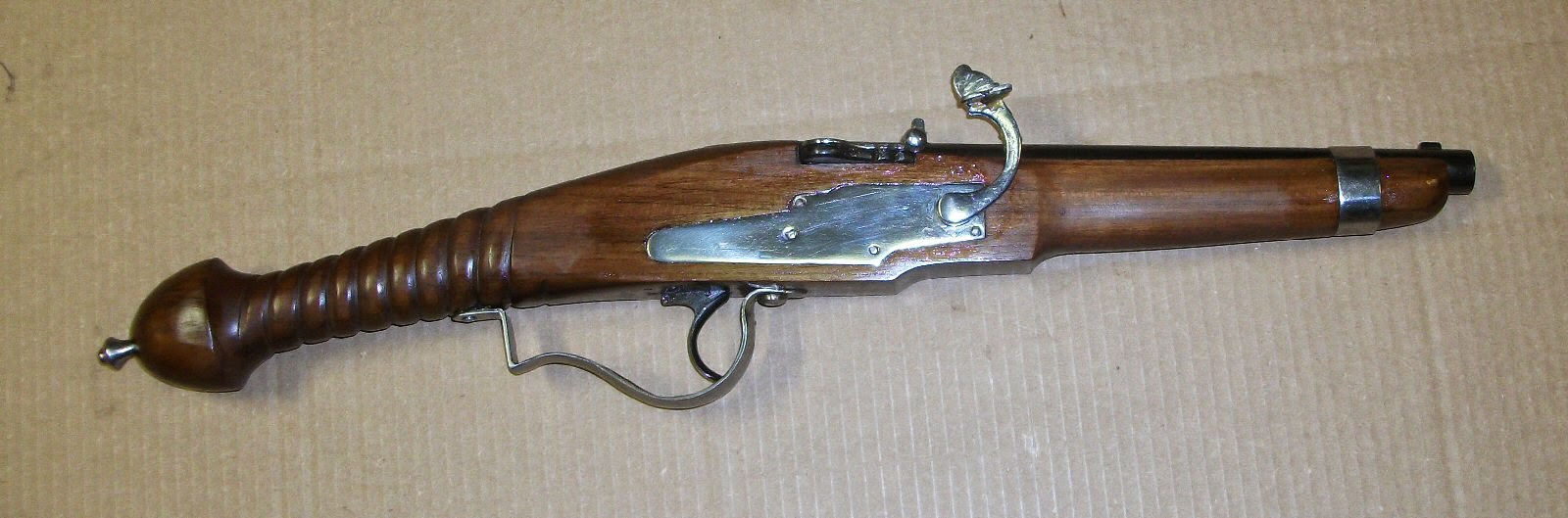
In 1509, the creation of the wheel lock made for an even more intriguing and advanced weapon. Contrary to the matchlock, which required a wick to ignite the gun for usage, the wheel lock was a steel wheel that created the spark needed to ignite the gun.
This wheel lock led to introduction of pistols. Slightly curved and with length of two feet made their way as gun of cavalry. But wheel lock used in the pistols was costly and hence army prepared cheaper matchlocks as replacements.
Wheel lock gun

The flintlock solved a longstanding problem. In the late 1500s, a lid was added to the flash pan design. To expose or protect the powder, the lid had to be moved manually. The flintlock mechanism was designed to push back the lid and spark a flint at the same time. The flintlock ignition system reigned for two centuries, with virtually no alteration.
Flint is an amazingly hard form of rock. If iron or steel is striked with flint, the flint flakes off tiny particles of iron. The force of the blow and the friction it creates actually ignites the iron, and it burns rapidly to form Fe3O4. The sparks are the hot specks of iron burning.  If these sparks come near gunpowder, they will ignite it.
Flintlock gun

The first multi-shot, revolving firearms that were mass produced came from Samuel Colt. Colt produced a gun that enabled people to fire multiple shots without reloading — a development that forever changed warfare.

Introduced at the start of the Civil War, Spencer repeating guns were technically advanced, used cartridges (a recent development), and could fire 7 shots in 15 seconds. But the Army didn’t want a repeating gun, fearing that soldiers would fire more often, constantly need fresh ammunition, and overtax the supply system.

But in 1863,President Lincoln test-fired a Spencer. His approval led to the purchase of 107,372 Spencer repeating carbines and rifles (of 144,500 made), and the Spencer became the principal repeating gun of the Civil War.

Winchester rifles were affordable, and became the generic rifle. The Winchester had such a powerful hold in some regions that it actually became known as "the gun that won the West." In 1887, Winchester came out with their first repeating shotguns.

The next major milestone for Winchester came in 1903, when the company introduced the first automatic rifle that would become widely used.

According to the National Firearms Museum, the first truly fully automatic machine guns (firearms that fire continuously while the trigger is held down) emerged in the 1880s when Hiram Maxim perfected the technology. Then, John Moses Browning followed these weapons up with the .30 caliber Model 1917 and the .50 caliber M-2 “Ma Deuce” — the latter of which is still used today.

Tuesday, February 24, 2015

AUTOMOBILE

The very first car might be the invention of a Flemish missionary Verbiest who was born in Flanders in 1623 and was an accomplished astronomer in Europe but left Europe for China in 1658.

He built a small, self-propelled vehicle which consisted of a rudimentary, ball-shaped boiler, which then forced steam towards a turbine that could turn the back wheels.


This was a remarkable achievement, but there were some pretty big caveats . The car was so small just like a toy car. It was about two feet long, far too tiny for any human to ride in it.

The 1700s were dominated by various inventors working to use the steam engine in automobile. Thomas Newcomen and James Watt were probably the most famous of these. But the first person to take a steam engine and place it on a full-sized vehicle was a Frenchman named Nicolas-Joseph Cugnot, who between 1769 and 1771 built a steam-powered automobile more than thirty years before the railway's first steam locomotive.

Cugnot's design was quite unique. The contraption weighed about 2.5 tons, had two big wheels in the back and a single thick central wheel at the front, and could seat four people. The boiler was placed well out in the front, which made the vehicle more difficult to control. While its top speed was meant to be about five miles per hour.


Most people agreed with the fact that it had poor weight distribution and so was unable to handle even moderately rough terrain. Since its intended purpose was as a transport for heavy artillery on the battlefield, that has to be considered a drawback.One story says that the second of Cugnot's two vehicles crashed into a wall in 1771, which might make it the first ever automobile accident.

Russian inventor Ivan Kulibin came with a steam-powered vehicle in the 1780s, and it featured plenty of modern automotive hallmarks, including brakes, gearbox, flywheel, and bearing. The problem is that, though it did have a steam engine component, it still required human peddling to operate, so it can't really be considered an automobile.

Steam-powered mass transit had some limited success in the opening years of the 1800s, but it wasn't until the 1820s and 1830s that steam buses began gaining popularity with the British public.
The steam buses proved to be something of a dead end, and engineers turned their attention to traction engines, which were slower, more stable machines that were basically just steam locomotives adapted for use on land.

The Locomotive Act of 1865 said no land vehicle could travel faster than 4 miles per hour, and that all such vehicles had to be preceded by a man waving a red flag and blowing a horn.

While steam remained the main focus of inventors in search of a practical automobile, the results remained difficult to control and incapable of reaching speeds much over about five miles per hour.

The internal combustion engine provided the pathway to the first modern automobiles, with Karl Benz generally getting the credit for the first successful invention in 1886.


Vehicles with electrical engines were also invented. Between 1832 and 1839 (the exact year is uncertain), Robert Anderson of Scotland invented the first electric carriage. Electric cars used rechargeable batteries that powered a small electric motor.

 The vehicles were heavy, slow, expensive, and needed to stop for recharging frequently. Both steam and electric road vehicles were abandoned in favor of gas-powered vehicles. Electricity found greater success in tramways and streetcars, where a constant supply of electricity was possible.


Austria has its own claim to the first inventor of the automobile in Siegfreid Marcus.   In 1870, Marcus  built a simple cart with a gasoline engine directly linked to the rear wheels.  This prototype had no steering, brakes, gearing, clutch or seat.  Marcus followed up the first prototype with a design for a second car, which was built years later in 1889.  The papers of Marcus were destroyed by the Nazis, who did not want to draw attention to the invention of an early automobile by a Jew. 

The first automobile to be produced in quantity was the 1901 Curved Dash Oldsmobile, which was built in the United States by Ransom E. Olds. Modern automobile mass production, and its use of the modern industrial assembly line, is credited to Henry Ford of Detroit, Michigan, who had built his first gasoline-powered car in 1896.  Ford began producing his Model T in 1908, and by 1927, when it was discontinued, over 18 million had rolled off the assembly line.


Monday, February 23, 2015

EYE GLASSES

Roman philosopher Seneca was known to use water-filled objects as a means to magnify text for reading as early as 4 B.C. It is believed that the Egyptians and Assyrians were the initial inventors of optical lens styles. They were depicted to made use of magnifying stones to enlarge text and print. Initially Magnifying technology was used for the purpose of vision correction and enhancing smaller images.


The first vision aid was invented around 1000 AD popularly known as reading stone. The reading stone was a glass sphere that was kept on top of the reading material to magnify the letters. The first wearable eye glasses were invented around 1284 in Italy. It is thought that Salvino D'Armate was their inventor but this claim has been proven to be totally false.

Early recorded evidence demonstrates that glasses first appeared in Pisa, Italy about the year 1286. Technically, they were formed from two primitive convex shaped glass/crystal stones. Each was surrounded by a frame and given a handle. These were then connected together through the ends of their handles by a rivet.

The 15th century marks a crucial time in the development of spectacles. The city of Florence by the middle of the fifteenth century led in innovation, production, sale, and spread of spectacles within and outside Italy as found in documents. Johann Gutenberg’s invention of the printing press around 1450 made use of glasses by artisans as well as monks and other religious scholars. By the end of the 15th century, spectacle peddlers were selling glasses on the streets of Western Europe. People often rummaged through baskets filled with German metal and leather spectacles in order to improve their vision. The purchaser tried several pair and finally selected the one giving clear vision. This demand increased exponentially after 1665, when the first newspaper, the London Gazette, appeared.

During the 17th century tinted lenses first became popular. Round lenses were almost universal. Until the end of the 18th century oval lenses became more popular and fashionable. The earliest frames were made of wood, horn, or bone. Leather frames had a relatively short life span but were popular from the 16th to the middle of the 18th century. Rectangular lenses became popular in the mid-1830’s. Some materials for later frames included brass, tortoiseshell from the hawksbill turtle, baleen, steel, silver, and gold. The cases also were often very finely crafted. The oldest existing spectacle case in the world was found in 1982 in Freiburg, Germany and it probably dates to the 14th century.

Aristocrats commonly used monocles as a status symbol and fashion statement. The elegant double eyeglass on a handle (scissors glasses) and the typically elaborate single lens magnifier (quizzer) had become common among the more fashionable members of French and German society in the second half of the 18th century. Both Lafayette and Napoleon used scissors glasses.

Lorgnettes, used most often by women, developed around 1780 from the scissors glasses of France and England. It is believed to have been first popularized by London’s George Adams, Jr. (1750-1795). They had a handle on the temporal side.


In England, especially between 1758 and about 1790, the so-called Martin’s Margins became popular. London optician Benjamin Martin (1704-1782) developed Visual Glasses in 1756 in an attempt to reduce the supposed damage to the eyes from excessive light. The aperture of the lenses was reduced by a horn annulus placed inside the ordinary sized frame.

Bifocals or split lenses were improvised most likely in London after the 1760’s by Benjamin Franklin (1706-1790). They were made by halving lenses of differing powers and positioning the segments together with a straight line across the middle. The upper portion was ground for distance vision while the lower portion was ground for the near vision. He was certainly wearing them and able to order them from local opticians by the mid 1780’s. Franklin wrote to London philanthropist George Whatley in May 1785, "as I wear my own glasses constantly, I have only to move my eyes up or down, as I want to see distinctly far or near, the proper glasses being always ready." Franklin’s split lens bifocal was the first "no-jump" bifocal, one hundred years ahead of its time, because the distant optical center, the near optical center, and the combined optical center were all at the same point.

As the 19th Century came to a close, more and more people wore their eyeglasses everyday.  A popular style of inexpensive, everyday spectacles was the pince-nez. French for "pinch nose," the pince-nez was first developed in France circa 1840 and began to be imported to America after the 1850s.

Pince-nez have no temples, but are fit snugly on the bridge of the nose. Pince- nez could be uncomfortable to wear and broke often from falling of the nose. The popularity of pince-nez was helped by political figures such as U.S. Presidents Teddy Roosevelt and Calvin Coolidge who wore them regularly.

Although pince-nez were still widely popular in the 1920s, they began to be seen as stuffy and old-fashioned. A Hollywood actor named Harold Lloyd was known for wearing tortoiseshell spectacles with large, round lenses. His photos and Hollywood movies started a fashion craze for temple spectacles.

In the 1930s sunglasses became popular for the first time. Sir William Crookes of England created a lens capable of absorbing both ultraviolet and infrared light. Further advances in sunglass design were accomplished in order to meet the needs of military pilots in World War II (1939 - 1945). As a result, manufacturers began to market sunglasses that were both practical and fashionable.

By the 1940s, advances in the manufacture of plastics made a large variety of spectacles available in every color of the rainbow. Women wore frames characterized by an upsweep on the top rim, a style that was very popular until the end of the 1950s, while men tended to sport gold wire frames.

By the latter half of the 20th century, spectacles were considered part of a person's wardrobe. More and more celebrities were influencing spectacle fashion, for example, in the 1970s Jacqueline Kennedy Onassis helped to popularize oversized lenses.


Wednesday, January 14, 2015

LOCK AND KEY

The lock originated in the Near East, and the earliest known lock to be operated by a key was the Egyptian lock. Possibly around 4000 years ago, the large wooden lock was found in the ruins of the palace of Khorsabad near Nineveh, the ancient capital of Assyria. 

The Egyptian lock is also known as the pin-tumbler type, and it evolved as a practical solution to the problem of how to open a barred door from the outside. The first and simplest locks were probably just a bar of wood or a bolt across a door. To open it from the outside, a hand-size opening was made in the door.

This pin-tumbler type lock consisted of a vertical wooden housing containing several loose wooden pegs of different lengths. These pegs fitted into holes bored in the top of a wooden bolt, preventing the bolt from being moved and the door from being opened. 

An oblique slot in the bolt provided access for a long wooden key with pegs of various lengths located on one surface and corresponding to the pegs in the vertical housing. When the key was inserted into the bolt and lifted, the pegs inside the housing lined up evenly at the top of the bolt, and permitting the door to be opened.


Specially designed large and heavy wooden key was shaped like modern toothbrush with pegs that corresponded to the holes and pins in the lock. This key could be inserted into opening and lifted, which would move the pins and allow security bolt to be moved.

During 1st millennia BC, locks finally started improving with the technologies and designs that were introduced by Greeks and Romans. Greek locks were commonly viewed as unsecure. They used a lock that worked by fastening the wooden bolt and staple to the inside of the door. The key was a sickle-shaped wooden or iron key manipulated and lift the bolt.

The ancient Romans built the first metal locks, and their iron locks and bronze keys are easily recognizable even today. They improved the Egyptian model by adding wards or projections or obstructions inside the lock that the key must bypass in order to work.

The Romans also invented the portable padlock with a U-shaped bolt which is known to have invented independently by the Chinese. Some Roman locks used springs to hold the tumblers in place, and the Romans made locks small enough that they could wear tiny keys on their fingers like rings.

The further development of the ward lock gave us padlocks. The Russians, Chinese, Turkish and East Indian used ornate metal padlocks which utilised all kinds of intricate designs.

In 1778, Robert Barron, invented the double tumbler lock. The tumbler is a lever that falls into a slot in the bolt thus preventing any movement, until picked up by the key to the height of the slot. This had to be done for each of the two tumblers at different heights, and then the key would slide the bolt. This innovation is still the basis of all lever locks.

In 1784, Joseph Bramah, displayed a lock to anyone who could pick it offering a prize of 200 guineas. In 1851, An American locksmith after trying for 51 hours was the first to open it and win the prize. In 1795, Bramah invented the hydraulic press, a check numbering machine and quill cutting machine to make the point or nibs of quills or pens.

In 1818 Jeremiah Chubb introduced an improved lever tumbler lock.

England had been the centre of innovations in lock-making for the past couple of centuries. It was Linus Yale Jr., son of an inventor & locksmith who started producing bank locks in a factory in Newport New York. He designed and patented the Yale infallible bank lock 1851. 

His factory in Shelburne Falls Massachusetts became famous for its innovative bank locks. The Yale magic bank lock and the Yale double treasury bank lock/.

In 1861, he introduced combination lock.  His most important invention was the cylinder lock based on ancient Egyptian design. In 1868 Linus and Henry Robinson Towne founded the Yale Lock Manufacturing Company and set-up a factory in Stamford Connecticut to produce cylinder locks.

In 1873, James Sargent of Rochester, New york patented a time lock mechanism that became the prototype of those being used in contemporary bank vaults. The time mechanism was concealed, utilizing as many as three clocks to cover a total of three days. The bolt was released, for the time the clocks were set to, and the safe then opened to the correct combination.

In 1916, Samuel Segal introduced first jemmy-proof lock and In 1924, Harry Soref in 1924 introduced first padlock.


Tuesday, January 13, 2015

TELESCOPE


The history of the telescope dates back to the early 1600s. Galileo Galilei is commonly credited for inventing the telescope, but this is not accurate. Hans Lippershey who was a lens maker is the real inventor of the telescope, being the first person to create the designs for the first practical telescope. Lippershey lived in Middelburg in the Netherlands.

Lippershey filed application for a patent on the 25th of September 1608 i.e. a few weeks earlier to  Jacob Metius who was also an instrument maker and optician in a city in the northern part of the Netherlands. Although he failed to receive a patent but was handsomely rewarded by the Dutch government for copies of his design. The telescope invented by Lippershey had a magnification of just 3x.

Another spectacle-maker Zacharias Jansen might prove a more lawful claim to have invented the telescope decades after the initial claims by Lippershey and Metius..

Galileo was the first person to use a telescope for the purpose of astronomy in 1609. In 2009 it completed a total of 400 years so celebrated as the International Year of Astronomy.

The Dutch diplomat William Boreel, who was apparently known to both Jansen and Lippershey in Middleburg during his youth, claimed that Lippershey stole his ideas from Jansen. Boreel was only being overzealous in his support of Jansen. There is no real evidence that Lippershey did not develop telescope independently.

Regardless of the inventor, most of the earliest versions of the telescope used a curved lens made of polished glass at the end of a tube to magnify objects to a factor of 3x.

Galileo had heard of the "Dutch perspective glass" by means of which distant objects appeared nearer and larger and constructed his own version of it without ever seeing one and stated that he solved the problem of the construction of a telescope in one night.

 Instead of the initial 3 power magnification, he crafted a series of lenses that in combination magnify things by 8, 20 and eventually 30 times.

He took it to Venice where he delivered the details of his invention to the public and presented the instrument itself to the Senate. Galileo may thus claim to have invented the telescope independently, although Galileo's immense improvement of the instrument overshadowed to a great degree the credit due to Lippershey as the original inventor.


The lens telescope is still in use today in smaller telescopes, but many larger and more powerful telescopes use a reflective mirror and eyepiece combination that was initially invented by Isaac Newton called a “Newtonian” telescope after its inventor. 

These types of telescopes have a polished mirror at the end of a tube, which reflects the image into an eyepiece at the top of the tube.

Sunday, January 11, 2015

AEROPLANE

The idea of flying high like birds and kites was the inspiration of the inventors of Aeroplane. Few decades back, there was a time when travelling was not as easy as it is today and flying in the air looked to be a dream never come true in real sense. One had to spend days for travelling from one part to another. Invention of Aeroplane made it quite easy to cover thousands of kms in very less time. It was a revolutionary invention for travelling across the world.

During 1880, Hiram Maxiam invented steam powered flying machine but the machine was too bulky impossible to fly in air. Samuel Langley also tried the steam powered planes and introduced one in 1894 that covered around 0.8 kms in around 1½ minutes. Then he designed another plane but its flights led to crashing in the lake. 

And finally in 19th century, the heroes- Wilbur Wright and Orville Wright came up and took the first step towards the successful invention of Aeroplane, was research through reading various books on it.

The real breakthrough in this research was the invention of "wing-warping." If the pilot wanted to bank a turn to the left, the wings could be warped to provide more lift on the wings on the right side of the biplane. The brothers worked out a system for 3-axis control that is still used today on fixed-wing aircraft: left and right like a car or boat, up and down and banking a turn as birds do like leaning to one side while riding a bicycle. 

Working with kites in 1899, the brothers figured out and tested their systems for 3-axis control. They chose a remote location at Kitty Hawk in North Carolina as the test site due its sand, wind, hilly terrain and for next two years did experiments with gliders at Kitty Hawk only. They used wind tunnel to find the proper lift. They found that the formula for lift that is "Smeaton coefficient"  in use for over 100 years  was wrong.

In year 1900, the Wright brothers tested the new biplane glider with 17 foot wing warping technique and wingspan, weighing 50 pound at the Kitty Hawk, in piloted as well unmanned flights. Based on the glider’s results, the brothers planned on refining landing gear and controls and designed a larger glider.

In the year 1901, at the Kill Devil Hill in North Corolina, the brothers flew largest glider ever with 100 pound weight and 22 foot wingspan. The wings did not have enough power to lift, forward elevator was not that effective and its wing warping technology caused it to spin out of control occasionally.

Wrights refused to give up in spite of all the problems being faced by them. They keep reviewing the test results till they found out that the calculations used for the mechanism were not up to the mark. Then they thought of building wind tunnel for testing the wing shapes and their effect on the lift. Based on the tests, the inventors understood how airfoil wing worked and calculated how well a wing design could work. Their plan was to design the new glider with around 32 foot wingspan and tail for stabilization.

The 1902 glider was actually the first fully controlled heavier-than-air craft. It was essentially more important invention than the 1903 biplane. On March 23, 1903, Orville and Wilbur Wright filed a patent application for a "Flying Machine." The patent was awarded May 22, 1906. From that point remarkable progress was made in the development of powered flight.

On Monday, December 14, 1903, the brothers decided that Wilbur would take the first turn as pilot for the historic flight by flipping a coin. They and the ground crew (5 lifeguards from the beach) had lugged the plane weighing six hundred pounds 1/4 mile to the big hill, laid out the 60-foot monorail, and were ready to go. 

Because of the slope and the force from the propellers there was a problem getting it unhooked. The plane accelerated down the track so fast that Orville, running alongside to steady the wing by holding on to an upright, couldn't keep up. Wilbur turned the sensitive rudder up too sharply, the flying machine nosed up, slowed, came down in that position, and the left wing hit the sandy hillside and swung the plane around, breaking several parts. It was not a real flight but they become more confident that it would work.

Two days later, repairs had been completed, but the wind wasn't right. The following day, Thursday, December 17, 1903, was the historic day. They realized it would be better to lay the track on flat ground. That and the strong (22-27 m.p.h.) winds meant that Orville (whose turn it was to pilot) was riding the plane along the track, at a speed that allowed Wilbur to keep up easily, steadying the right wing as Orville had done 3 days earlier. 

Just after the Wright flyer lifted off the monorail, the famous picture was taken, possibly the most reproduced photograph ever, which Orville had set up. The flight was just for 12 seconds, 120 feet. But it was the first controlled, sustained flight in a heavier-than-air craft, one of the great moments of the century.

The brothers flew 3 more times that day, covering more distance as they got used to the way the large front "rudder" (the elevator) responded in flight. Orville's second flight was 200 feet, and Wilbur's before it nearly as long. But the final flight of the day carried Wilbur 852 feet in 59 seconds.

The Wright brothers soon realized that their success was not appreciated by all. Many in the press, as well as fellow flight experts, were reluctant to believe the brothers’ claims at all. As a result, Wilbur set out for Europe in 1908, with a hope to have more success convincing the public and selling airplanes.

Wrights began to sell their airplanes in Europe, before returning to the United States in 1909. The brothers became wealthy businessmen, filling contracts for airplanes in Europe and the United States.

Their first powered Aeroplane was named Flyer. It was plane with two wooden wings which were 40 feet wide, covered with the cotton cloth, 12 horse powered engine. This plane demanded pilot to be in lower wing on his stomach for the steering. 

And in year 1908, another plane was introduced by the brothers that stayed in the air for about 1½ hours. In year 1909, the brothers got a contract from US military for building first plane for them. In 1911, Calbriath Rodgers was the one that made first flight across U.S possible.

 Since then, Airplane travel has improved a lot. Airplanes now cover thousands of miles at great altitudes of 7 miles and more, carrying around 300 passengers. Jet engines have now replaced the propellers and they travel with speed of more than 600 miles every hour. 

Not even Wright Brothers would have imagined the way air travel has turned today. Consistent efforts and hardwork of the Brothers and other inventors have offered the comfort of air travel today. The best part is that in innovations never stop, they are ongoing. So, one can look forward to advancements in the field.

Wilbur fell ill on a trip to Boston in April 1912. He was diagnosed with typhoid fever, and died on May 30 at his family home in Dayton, Ohio. Milton Wright wrote in his diary, “A short life, full of consequences. An unfailing intellect, imperturbable temper, great self-reliance and as great modesty.